
Ori Studio
English
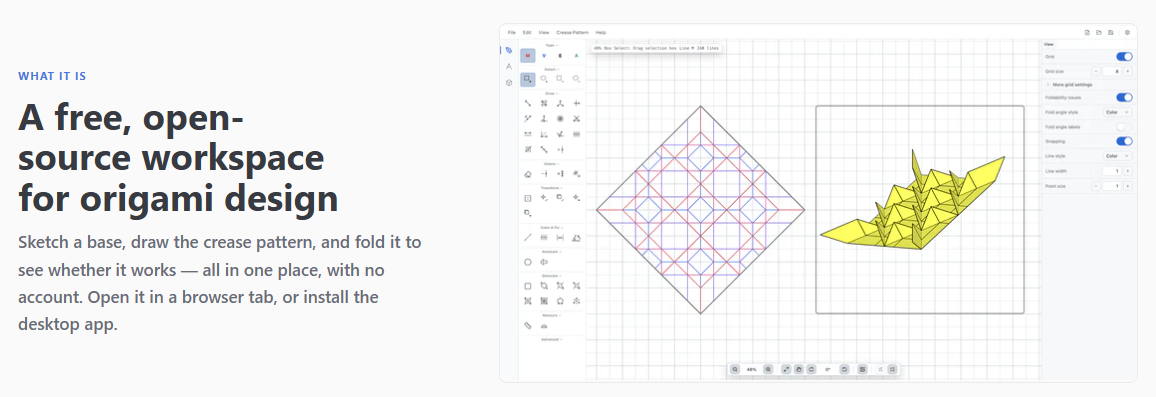
Ori Studio aims to be the ultimate workspace for origami design and analysis. It combines a modern web and desktop interface with a family of Rust and WebAssembly engines, and it leans heavily on ports of existing origami tools created by the community. The bulk of the functionality is dedicated to creating and editing origami crease patterns through a fork of Oriedita. It also incorporates ports of Treemaker and Box Pleating Studio.
While the ports serve as the base for functionality, additional tools and functionality are being built on top of them - for example the edit workspace supports adding images next to crease patterns, which is useful as you are designing for references of the subject. Another is Detect CP from Image (File menu, in beta): a photo or render of a square crease pattern is cropped, run through a detection model, and solved into an exact, editable pattern — the model downloads once (45 MB) and is kept on the device; Settings ▸ Models shows what is installed. However, maintaining compatibility with existing tools is a priority - you will always be able to export to to a .ori file, which will just omit the images.
The Diagram workspace turns a pattern into printed folding instructions: each step links to a sheet of the crease pattern (shown as its crease pattern, folded, or in the simulator) or takes a card from References, gets fold arrows and symbols, and the steps are laid out on pages and exported as a PDF or a ZIP of pictures.
The Fold workspace folds a sheet step by step, the way you would by hand: locate a line with the Huzita–Justin axioms or an existing crease, then make a valley, mountain or precrease fold, or a reverse, squash, petal, rabbit-ear, swivel, crimp, pleat or sink fold, through the layers you pick. After every step you see the flat folded form and its crease pattern. A sequence can start from a crease pattern, repeat a run of steps on the other side, unfold back to an earlier step, and send its steps to the Diagram as illustrated steps.
Try the hosted app at oristudio.dev. Signed Apple Silicon DMGs are published from local notarized builds on GitHub Releases (other platforms coming soon, community help would be appreciated!).